

Position Analysis of a 4 Bar RRRR Non Grashofian Double Rocker Mechanism
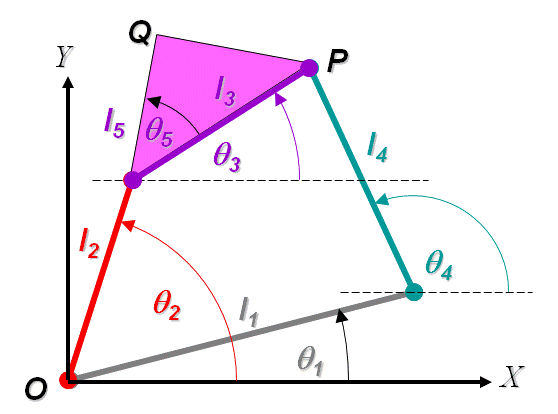
Schematic Diagram of a 4 Bar RRRR Linkage
The 4 bar RRRR mechanism is forms the basis of any study on mechanism. It is widely used in various forms because of the relative simplicity of design and manufacture as well as durability. Grashof's criteria is used to distinguish between 4 bar RRRR linkages depending on the rotatability of the individual links of a 4 bar mechanism. In brief, if l is the longest link, s the longest link and the other two links have length p and q then the following cases arise
- l + s < p + q : Grashofian linkage
-
- l + s < p + q , shortest link s is the ground link : Double Crank
- l + s < p + q , shortest link is the coupler : Double Rocker
- l + s < p + q , shortest link is neither coupler nor ground : Crank Rocker
- l + s > p + q : Non Grashofian Double Rocker
For a more detailed introduction to Grashof criteria see the animated guide that follows. If undisturbed , the animation will proceed at a predetermined pace. You can either click on the animation itself to move from step to step as per your convenience. Alternatively you can use the controls at the bottom of the animation to see it at your own pace.
In a Crank Rocker, unlike a Double Crank, only the input link (link 2, which is the crank) rotates through a full circle about the ground (link 1, which is the frame), while the output link (link4, which is the rocker) does not. The output link oscillates instead between two limiting positions. Thus the position analysis of a Crank Rocker involves, apart from finding out the coupler curve and the relation between the input and output orientations, finding the limiting posiitons of the link 4 and the corresponding positions of link2. Since the input link rotates through a full circle it is still possible to drive this mechanism using a simple continuous rotary drive, that is we may connect it directly to a simple motor. However we cannot connect the output to a continuous rotary drive directly since the output link moves back and forth.

Animations of a Grashofian and 3 types of Non Grashofian Double Rockers
- Clicking on the buttons will rotate the crank in the directions indicated (CW=clockwise, CCW=counterclockwise). The slider can be used for controlled rotation.
- The view can be rotated about a point by keeping the left mouse button pressed and rotating the mouse.
- The view can be translated by keeping the right mouse button pressed and translating the mouse in the desired direction
- The scroll button or middle mouse button can be used for zooming.
- The view can be rotated about the coordinate axes by using the left (<--) and right (-->) keys and the Page Up and Page Down keys on the keyboard.
- Using the Up Arrow and Down Arrow keys will move the view towards or away from the viewer.
- The - and + (or Shift + =) keys may be used for zooming out and zooming in.
- Pressing the = key will get the view back to default.

In this experiment you will guided through the position analysis of a 4 bar RRRR Non Grashofian Double Rocker. Unlike a double crank, or a crank rocker, the double rocker has no crank in the sense that its input link which in this case is the link 2, CANNOT complete a full rotation and there will be a lower and upper limit for the values of theta 4.. Like a crank rocker, in a doublerocker, the follower, which in this case is the link 4, will also NOT rotate through a full circle, and there will be a lower and upper limit for the values of theta 4. The methods of position analysis of a Double Rocker are the same as that for a double crank or crank rocker. Using complex numbers is a popular analytical approach. The location of the coupler point can also be determined graphically. An animated description of the analytical as well as graphical methods are provided in the following links.
As with a crank rocker if we try to analytically find out the extrema of the roots of theta 4 by taking derivative of theta 4 with respect to theta 2 and setting the value to zero, it will ultimately be seen that the values are non zero and different, implying that there is a range of values of theta 4. Likewise if we examine the roots of theta 4, it will also be seen, that unlike the case with a crank rocker, real values of theta 4 will exist only for a certain range of theta 2. However the simple geometrical consideration that in the extreme configurations, the 4 bar linkage will form a triangle lets us easily find the limits both analytically and graphically. The following animations show the analytical and graphical methods. The double rocker can be both Grashofian and Non Grashofian. The Grashofian double rocker is only of one type. the non Grashofian has 3 variants. In the Grashofian double rocker, two modes of assembly are possible for a given set of link lengths, the peculiarity being that if the mechanism is assembled in one mode the configurations reached by the other mode are never achieved. Thus the complete coupler curve actually consists of two different non intersecting curves. In fact this is a trait common to Grashofian double crank and crank rocker also. However in the Non Grashofian Double Rockers, such is not the case. One mode of assembly switches to the other at some point and ultimately a single coupler curve is obtained. This will be seen in the position analysis of NonGrashofian Double Rockers.

Choose link lengths, preferably keeping them within 10 units length for easy viewing of animations. Enter them and a coupler arm length and orientation of your choice in the following applet in the designated text boxes. Link 1 represents the ground link. Press the Enter button to verify if your data conforms to a Grashofian Double Rocker. Note that coupler arm length and orientation play no role in Grashof's criteria, but you are merely asked to enter them for use in later stages. In case you get a message stating that your data does not conform to a Grashofian Double Rocker,
Once your link lengths are validated, you are expected to find out graphically the limiting positions of the double rocker using the Drawing Board Applet which will open when you click the link below. A new browser window will open along with the applet. Since the linkage is a crank rocker, therefore the follower link will rotate between two limits of theta 4. You are required to find those limits using this applet. The applet uses screen coordinates for drawing. Hence if you are using link lengths between 1 to 10 units it is advisable (although zoom is available for the applet) to choose a scale between 100:1 to 10:1 for easy on screen use.

[JAVA Applet Simulator] [Java Script Simulator]
To get an animated guidance of the graphical analysis using the applet clink below
How to use the Drawing Board to find limit positions of the Crank Rocker graphically
Validate your answer using the applet below

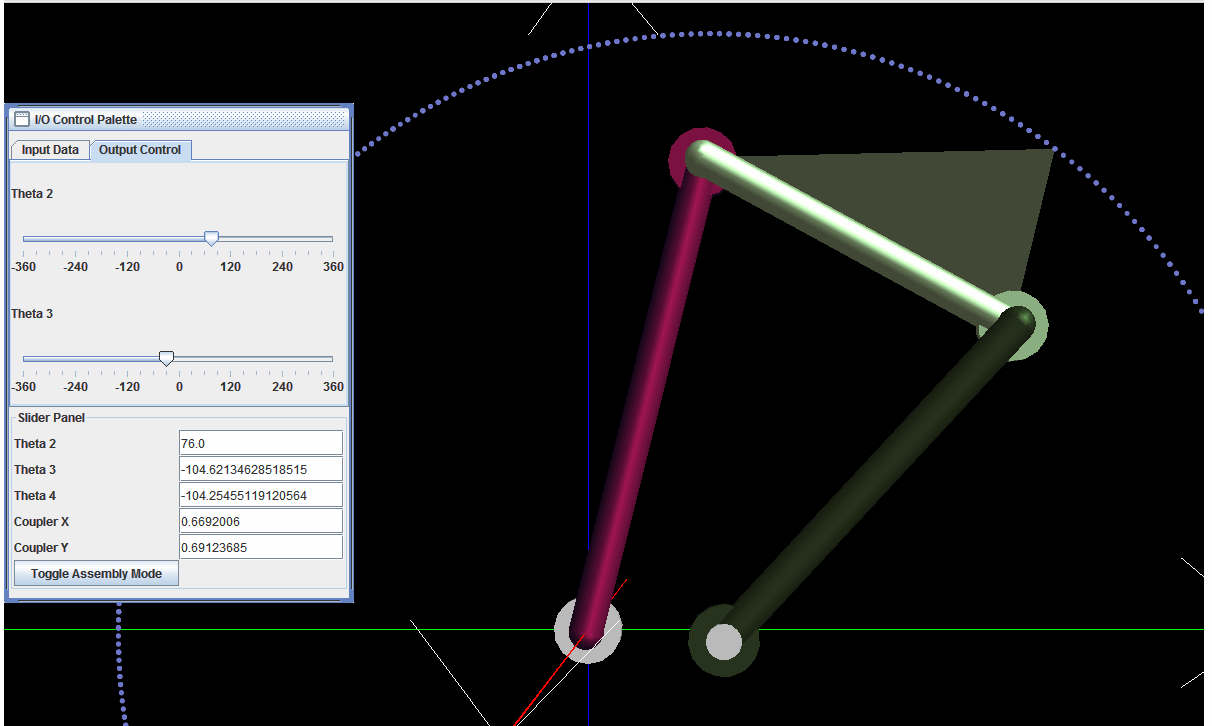
The simulator applet allows you to assemble your RRRR mechanism and run it. Click on the image below. A new browser window or tab will open with the applet. The applet is very similar to the animation in the Demo Tab and the instructions for using it apply to this applet as well. Perform the following tasks using the simulator. Use the mouse to drag the I/O Control Palette to any convenient location.
- Click on the Input Data tab. Provide the link details i the designated text boxes that appear under this tab. Click on the Update Button.
- Click on the Output Control tab. Use the slider labeled Theta 2 in the menu provided to rotate the crank. Obtain the complete coupler curve. The output data will be displayed in the Slider Panel in the designated text boxes. Run the mechanism through its full range of theta2. Compare the mechanism configuration with that obtained through graphical analysis to validate your results.
- Click the Toggle Assembly Mode button to run the mechanism in the two feasible assembly modes
- Drive the mechanism by rotating the coupler in place of the crank by using the slider labeled Theta3. Run in both the assembly modes by clicking the Toggle Assembly Mode button.

- A. K. Mallik, A. Ghosh and G. Dittrich - Kinematic Analysis and Synthesis of Mechanisms, CRC Press Inc. Boca Rato
- A. Ghosh and A. K. Mallik - Theory of Mechanisms and Machines, Affiliated East-West Press (P) Ltd., New Delhi
- Kenneth J. Waldron, Gary L. Kinzel - Kinematics, Dynamics And Design Of Machinery, Wiley India Pvt Ltd
- John Joseph Uicker, G. R. Pennock, Joseph Edward Shigley - Theory of machines and mechanisms , Oxford University Press
- Arthur G. Erdman, George N. Sandor, Sridhar Kota - Mechanism Design: Analysis And Synthesis, Prentice Hall
- Atmaram H. Soni -Mechanism Synthesis and Analysis,, McGraw-Hill Inc.,US